Supporting your child’s future
Providing services and facilities to our local communities
Grades 9-5 in English and Grades 9-4 in Maths, Science and two or more GCSEs at grades 9-4 or A*- C. There is no requirement for you to have studied Psychology at GCSE.
Why Choose A-Level Psychology?
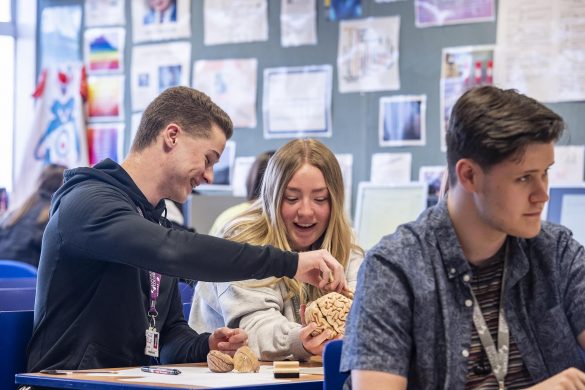
Psychology is the scientific study of the mind and behaviour, offering valuable insights into how people think, feel, and act. Choosing A-Level Psychology gives students the opportunity to explore complex questions about human nature, gain a deeper understanding of themselves and others, and develop a skill set that is highly valued across many professions. Whether you’re interested in healthcare, education, business, or beyond, studying psychology provides a strong foundation for a wide range of career paths.

Our A-Level Psychology course covers diverse and engaging topics including:
Through these topics, you’ll explore the theories, research studies, and key debates that have shaped modern psychology, providing you with a broad and balanced understanding of the field.
Click here for link to Exam Board specification for Psychology A Level
A-Level Psychology is designed to foster both subject-specific and general academic skills, including:
These skills are essential not only in psychology but are highly transferable to other fields, preparing you for a wide range of future studies and career opportunities.
Transferable Skills and Real-World Impact
Studying psychology teaches skills that are valuable across various domains, including:
Psychology also has a profound real-world impact. Knowledge of psychological principles is key in fields like mental health care, education, and social work, and is essential for anyone wanting to make a positive impact on individuals and communities.
Further Education
A-Level Psychology opens doors to a variety of undergraduate courses, such as:
Career Opportunities
Psychology graduates have a wide range of career paths to consider, including:
An A-Level in Psychology equips students with a versatile skill set, critical thinking capabilities, and a deeper understanding of human behaviour, all of which are highly valuable in today’s world

For more information contact:
James BaileyPosition: Director of College Operations